The economic growth is likely to moderate to 6.1 per cent, slowest in over seven quarters, from 6.6 per cent last year same period.

Gaurav Garg, head of research at CapitalVia Global Research Limited will answer your stock market queries.

Continuing its heavy selling spree for the eighth consecutive month, foreign investors pulled out nearly Rs 40,000 crore from the Indian equity market in May on fears of an aggressive rate hike by US Federal Reserve that dented investor sentiments. With this, net outflow by foreign portfolio investors (FPIs) from equities reached at Rs 1.69 lakh crore so far in 2022, data with depositories showed. Going ahead, FPI flows will remain volatile in the emerging markets on account of rising geo-political risk, rising inflation, tightening of monetary policy by central banks, among others, Shrikant Chouhan, Head - Equity Research (Retail), Kotak Securities said.

Echoing Prime Minister Narendra Modi's views that improving the health of financial markets alone cannot fuel growth, G20 business leaders on Friday said vigorous efforts should be made to go beyond fiscal and monetary policy to kickstart world economy and create jobs.

All-out efforts are needed to mitigate the adverse impact of the Covid-19 pandemic, and the RBI will use any instrument necessary to revive growth and preserve financial stability, according to the minutes of the central bank's policy meeting.

Retail investors have become a force to reckon with in the last 10 years with their ownership of Indian equities rising 800 basis points, or 8 per cent, to 23.4 per cent during this period, suggests a recent note from Morgan Stanley. This number, Morgan Stanley said, is set to rise in the next few years as Indian households are still underinvested in equities. India's demographics, policy framework, investor education and modest positive real rates, it said, will fuel the 'equity cult' in India.

The World Bank on Tuesday raised the growth forecast for the Indian economy to 7 per cent for the current fiscal year on the back of recovery in agri sector and rural demand. World Bank had in June projected India to grow at 6.6 per cent for FY24. According to the World Bank Report released on Tuesday, India's growth continues to be strong despite a challenging global environment.

By taking the mutual fund route, investors can take exposure to gilts with small amounts. Over a decade or more, returns from these funds tend to be sound.
Shares were also buoyed by positive global sentiment on hopes major central banks will ease monetary policy further or continue to keep it loose for long.

Average policy rate over the next three years should be around 7.4%
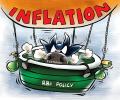
The RBI on Friday retained inflation forecast for FY23 at 6.7 per cent amid uncertain price trajectory on "geopolitical shocks" and on hope that inflationary pressures would ease with pick-up in kharif sowing and supply chain improvements. In its previous monetary policy review in June, it had projected retail inflation for 2022-23 at 6.7 per cent, higher from 5.7 per cent forecast in April. The six-member Monetary Policy Committee (MPC) unanimously decided to raise the benchmark repo rate by a steep 50 basis points to 5.40 per cent with immediate effect to tame inflation while supporting growth.

India's economic growth will be above 6 per cent in the current fiscal as the country has managed to strengthen its macroeconomic stability and performance even in a period of large global shocks, RBI Monetary Policy Committee (MPC) Member Ashima Goyal said on Monday. Goyal further said that a global slowdown reducing India's export growth, geopolitics fueling oil and food prices, and erratic weather are some of the continuing risks that the country faces. "India has managed to strengthen its macroeconomic stability and performance even in a period of large global shocks.

Head of central banks from various countries get into a 'Basel huddle' every second month at Basel at the headquarters of the Bank for International Settlement.

Against the Reserve Bank of India's (RBI's) projection of 7.1 per cent, India's first quarter (Q1) 2024-25 (FY25) gross domestic product (GDP) growth came in at 6.7 per cent. This is in line with market expectations and significantly lower than the 7.8 per cent recorded in the fourth quarter (Q4) 2023-24 (FY24) and 8.2 per cent in Q1FY24. The quarter witnessed decreased government consumption and investment spending due to the parliamentary election.

'Any normalisation exercise will bring its share of volatility.'

The former RBI deputy governor talked about the prospects of an economic revival, reforms in IMF, etc.

Retail inflation inched up to 4.48 per cent in October due to an uptick in food prices, government data showed on Friday. The Consumer Price Index (CPI) based inflation was at 4.35 per cent in September and 7.61 per cent in October 2020.

RBI Governor Shaktikanta Das has assured Finance Minister Nirmala Sitharaman that the Rs 12.05-trillion gross borrowing programme for FY22 will go through smoothly.

The Indian economy is projected to grow at 6.3 per cent in current financial year aided by investment and domestic demand. According to a World Bank report released on Tuesday, India continues to show resilience against the backdrop of a challenging global environment. In India, which accounts for the bulk of South Asia region, growth is expected to remain robust at 6.3 per cent in 2023-24, India Development Update of the World Bank said.
Most members of the monetary policy committee (MPC) argued for front-loading interest rate hikes in view of rapidly rising inflation during the off-cycle monetary policy review earlier this month - the minutes of the meeting published on Wednesday showed. In early May, the rate setting committee met unscheduled and unanimously decided to hike the repo rate by 40 bps. This was the first repo rate hike in four years, and an inter-meeting hike in more than a decade.

He argued that if inflation is low, stable and moving towards the 4 per cent target, why has the RBI not revised downward the bank rate fixed in June 2023?

Capital expenditure by Indian companies is likely to see an uptick in the upcoming quarters as capacity utilisation has surpassed the critical threshold of 75 per cent, and numerous companies have deleveraged their balance sheets, according to analysts. The first quarter of the current financial year has shown improved profitability, driven by a decrease in input prices. This, according to analysts at Care Ratings, should stimulate a revival in the private capex cycle.

The S&P BSE Sensex shed 286 points to close at 24,539 and the Nifty50 lost 100 points to end at 7,456.

The number of mergers and acquisitions (M&As) in August that involved private equity (PE) funds was the lowest in nearly three years. There were 26 such deals last month, according to data from tracker Refinitiv (part of London Stock Exchange Group). The last time monthly deal numbers were so low in recent times was January 2021 when Covid cases were picking up during the second wave of the pandemic.

Indian economy is gathering momentum in the second quarter, though inflation would continue to average above the central bank's comfort zone of 6 per cent, said an article in the RBI's monthly bulletin released on Thursday. The consumer price index (CPI) based retail inflation shot up significantly to 7.44 per cent in July, from 4.87 per cent in the preceding month, mainly due to soaring prices of tomato, vegetables and other food items. In his address to the nation on the Independence Day, Prime Minister Narendra Modi vowed to take more steps to contain price rise.

Crude oil has fallen about 40 per cent since mid June and the price on Monday touched its lowest level since mid 2009 before US oil prices posted their biggest one-day gain in two years overnight.

Declining vegetable prices brought down the retail inflation to a 15-month low of 4.59 per cent in December and within the comfort zone of the Reserve Bank, government data showed on Tuesday. It is for the first time during the current fiscal that the Consumer Price Index (CPI) based inflation print is below 6 per cent or in the RBI's target range of 2 to 6 per cent. The central bank factors in the CPI-based inflation while arriving at its monetary policy. The inflation in December 2020 came down from 6.93 per cent in November, mainly on account of 10.41 per cent decline in vegetable prices over the year-ago period.

The roots of the global food situation lie far beyond the scope of interest rates and cash reserves.

Inflation is a big concern for India, says RBI chief Raghuram Rajan.

Probably 35 bps. There could be even an encore in February 2023 to take the policy rate to 6.5% before the financial year ends, predicts Tamal Bandyopadhyay.

Kotak Mahindra Bank was the biggest loser from the Sensex pack, skidding 1.83 per cent, followed by Axis Bank, NTPC, Hindustan Unilever, ICICI Bank, Bharti Airtel, Reliance Industries, HCL Technologies, IndusInd Bank and Nestle. In contrast, Bajaj Finance, Bajaj Finserv, Tech Mahindra, Tata Consultancy Services, Titan, Infosys, HDFC Bank, HDFC and ITC were the gainers.

The biggest risk to India's growth outlook is an escalation of geopolitical tensions, especially if these tensions spread to the Asian region, RBI Monetary Policy Committee (MPC) member Jayanth R Varma said on Wednesday. Varma, in an interview to PTI, said that inflation and inflationary expectations appear to be moderating and high inflation will certainly not become the 'norm' in the country. He is cautiously optimistic about the Indian economy as after the pandemic abated, consumption demand has begun to recover though the recovery is uneven across sectors and industries.

From the Sensex firms, Tech Mahindra jumped 5.58 per cent, followed by Nestle, Tata Steel, NTPC, Tata Consultancy Services, Asian Paints, Wipro and Bajaj Finserv. Mahindra & Mahindra, Hindustan Unilever, Axis Bank and Bajaj Finance were among the major laggards.
.jpg)
CII hopes that the RBI would not wait for the next quarterly review but intervene sooner if the economic condition warrants a mid-course correction.

The TIME 100 AI list is an interesting assortment of titans. Indians make up about 20 per cent of the coveted list, which is pretty commendable, notes Sandeep Goyal.

Investors have been hoping for a cyclical recovery.

The Reserve Bank on Wednesday retained the GDP growth forecast at 9.5 per cent for the current fiscal but cautioned that the economic recovery is not yet strong enough to be self-sustaining and durable.

Shaktikanta Das said in Washington, DC, that there was nothing sacrosanct about the 25 bps rate cut and that monetary policy could be well served by calibrating the size of the policy rate to the dynamics of the situation, and the size of the change itself could convey the stance of policy.

Sentiments were also bearish largely in tandem with a sell-off in global markets as US Treasury yields surged to multi-year highs on robust economic data and comments from the Federal Reserve, sparking fears of accelerating inflation, brokers said.